Showing posts with label Earnings/Reports. Show all posts

Thursday, 19 October 2006

Seeing higher earnings in your channel reports?

Have you ever looked at your ad reports and noticed that your channel data and your aggregate data don't match, even for the same date range? You're not alone -- we often receive emails from publishers who are concerned about this issue, and we're happy to clarify what's going on. Depending on how you've set up your channels, you'll see a larger number of page impressions, clicks and earnings in your channel reports than your aggregate reports for any or all of the following reasons:
  1. Your ads are being tracked on multiple URL channels.

    Let's say you've set up 2 URL channels - one to track example.com and to track www.example.com/page. The URL channel example.com will track clicks and impressions from all subdomains, subdirectories, and subpages of example.com. As a result, one click on www.example.com/page will be tracked on both of your URL channels, which means you'll see two clicks recorded in your channel reports. However, your aggregate reports will show you the correct number of clicks, one, with no data duplication. You can learn more about how URL channels will track specific pages in our Help Center.

  2. Your ads are being tracked on both a URL and a custom channel.

    Now let's suppose you have a URL channel for example.com and a custom channel called Example Homepage, which you're using on the homepage of example.com. When you receive a click on the ad unit tagged with your Example Homepage custom channel, it will also be tracked on your example.com URL channel. Just like above, this means that you'll see two clicks logged in your channel reports, but only one in your aggregate reports.

  3. Your ads are being tracked on multiple custom channels.

    So you've taken advantage of our new feature, and you're tracking each of your red leaderboards with 2 custom channels -- one called Red_ad_units and one called Leaderboards. One click on a red leaderboard will be tracked in both of your custom channels, so you'll see twice as much data when you compare your channel reports to your aggregate reports.
Of course, this doesn't mean that you shouldn't set up multiple URL and custom channels to track specific pages and ad units. But if you'd like to view the overall performance of your account, visit your Advanced Reports page, select the Aggregate Data radio button, and click Display Report -- you'll then see your reports without any duplicate data.


Now get tracking (correctly)!

Monday, 25 September 2006

Unlocking the relationship between CTR and earnings

Here's an AdSense mystery worthy of intrepid detective Veronica Mars: Why are increases in clickthrough rate (CTR) sometimes accompanied by decreases in earnings per click?

Occasionally, we hear from publishers who are perplexed that their earnings don't change despite an increase in CTR. This phenomenon can seem inexplicable, and when it happens, publishers may suspect that 'smart pricing' has taken effect, or that Google is making revenue share changes. What's really going on?

AdSense is unique because it's designed to maximize eCPM for our publishers, taking into account both the advertiser's cost-per-click (CPC) bid and the likelihood that the ad will be clicked. Some ads are attractive to a broad range of site visitors and will be clicked on more frequently. While this can be great for your CTR, advertisers are often bidding less for these kinds of broadly targeted ads. Other ads are attractive only to a small niche of users. Advertisers will typically pay more for these tightly targeted ads, but those ads are also less likely to get clicked.

Depending on ad inventory, you may see some days on which AdSense will show a lot of high CTR/low CPC variety ads. On other days, you may see the reverse. If you see this correlation in your own AdSense reports, keep in mind that we're always working hard to maximize revenue for our publishers. One aspect of that is being able to best take advantage of the earnings characteristics of different kinds of ads.

Thursday, 13 April 2006

Earnings: Your questions answered

Is there is a minimum number of impressions or clicks I need to get before I can start earning through AdSense?

No, there's no minimum number of impressions or clicks for generating earnings. You can start earning the very first time a user clicks on a cost-per-click (CPC) ad or views a cost-per-thousand-impressions (CPM) ad. Keep in mind, however, that you'll need to earn $100 before your earnings will be paid out to you.

If a CPM ad appears on my site, do I need to receive 1,000 impressions before I am paid?

No, with CPM ads you're paid for each impression, so if you receive 1 ad impression, you'll receive 1/1,000 of the CPM bid for that ad unit.

I received 57 page impressions. Why don't I have any earnings?

It sounds like the ads currently appearing on your site are probably CPC ads, so you'll be paid for clicks, rather than impressions. Our system will automatically display whichever ad or ads representing the highest revenue potential for you, whether they're CPC or CPM ads.

How much do you pay per click or impression?

We don't pay a fixed price for each click or impression - we pay you a portion of the amount paid by the AdWords advertiser. This amount varies based on the actual CPC or CPM paid by the advertiser. Each ad that appears on your site will most likely generate a different CPC or CPM.

Do I get paid when visitors use my search box?

With AdSense for search, you'll be paid when users click on the ads that appear on their search results pages, not from the search queries themselves. You won't be paid if a visitor uses your search box, but chooses not to click on the ads on the search results pages.

Do I get paid when visitors click on my link unit topics?

When a user clicks on a link unit topic, you'll be paid for clicks on the CPC ads that appear on the resulting page of highly targeted ads. However, you won't be paid for clicks on the initial topics themselves. Link units can siginficantly boost your overall AdSense revenue by providing even more relevant and monetized content to your users.

Friday, 31 March 2006

CPM ads: Knowing the facts can pay off

We've received lots of questions asking for clarification about the relationships between ad type (text vs. image), bidding method (CPM vs. CPC) and targeting type (site vs. contextual). To clear up any confusion, we've separated several myths from the facts.

Myth: All text-based ads are paid on cost-per-click (CPC) basis, and all image-based ads are paid on a cost-per-thousand impressions (CPM) basis.

Fact: Both text and image ads can be paid on either a CPC or CPM basis. AdWords advertisers can choose which type of ad they'd like to create -- e.g., CPM vs. CPC or text vs. image. In order for a CPM ad or an image CPC ad to win in the ad unit auction and appear on your site, it has to produce an effective CPM greater than the sum of the individual text ads that would otherwise appear.

Myth: If I set my ad unit to 'image only', I'll get exclusively CPM ads.

Fact: As mentioned above, image ads can be either CPC or CPM ads, so you could also see CPC image ads. You might also see public service ads if there is a limited inventory of image ads relevant to your site content. As a rule of thumb, we recommend opting into both text and image ads. Doing so expands the pool of advertisers competing to display on your site – both on a CPC and CPM basis – therefore maximizing your site's revenue potential. It also helps to choose an ad format that supports both text and image ads.


Keep in mind that currently, all CPM ads are site targeted, meaning that your site will only display CPM ads if an AdWords advertiser has decided your content is relevant to their ad campaign. To increase advertiser bidding on your site, you may wish to customize your Onsite Advertiser Sign-up landing page.

Myth: I can't participate in Onsite Advertiser Sign-up because I only want to display text ads on my site.

Fact: Since site-targeted CPM ads can be either text-based or image-based, you can still take advantage of this program even if you only want to show text ads. Advertisers who want to display on your site can create text-based site-targeted ads.

Friday, 3 March 2006

Why the lower eCPM?

Now that site targeted and contextually targeted ads can be displayed separately in AdSense Advanced Reports, there seems to be some confusion about site targeted ads with lower eCPM. We'd like to explain why you should always feel assured that you're getting the best paying ads for your pages.

Site targeted ads compete in the same auction as contextually targeted ads. They will only appear on your site if they represent a higher eCPM than any combination of contextually targeted ads competing to display in the same ad unit. The AdWords auction process takes into account factors such as bid price and clickthrough rate in calculating Ad Rank, the ranking system determining which ads will appear on your page. Opting into site targeted ads should only improve your overall revenue potential by deepening the pool of advertisements competing to display on your sites.

So why is the eCPM associated with site targeted ads sometimes lower than the eCPM associated with contextual ads in your Advanced Reports? The answer is that site targeted ads are most likely appearing on lower performing pages within your account – in other words, pages requiring a lower eCPM to win the AdWords ad auction. For example, say your ad unit on 'PageA.com' has an eCPM of $5.00, and a combination of contextually targeted ads are displaying. Your ad unit on 'PageB.com' has an eCPM of $1.00, and a site targeted ad is displaying because it represents the highest revenue potential for this page.

If these are the only two pages on which you are displaying AdSense ads, your Advanced Reports will show an eCPM of $5.00 for contextual ads, and an eCPM of $1.00 for site targeted ads. However, all of your ad units are automatically optimized to display the highest paying ads available at that moment.


Lastly, please remember that site targeted ads pay on a cost-per-thousand impressions (CPM) basis, not on a cost-per-click (CPC) basis, so you will be paid whether or not your visitors click on them. For site targeted ads, clickthrough rate does not affect eCPM since advertisers bid on a cost-per-thousand impression basis rather than a cost-per-click basis.

Monday, 27 February 2006

eCPM -- what exactly is that?

eCPM is a bit of industry shorthand that seems here to stay. You've seen it listed in your AdSense reports; it means, "effective cost per thousand impressions." So how is eCPM calculated, you ask?


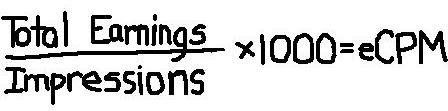
eCPM is calculated by dividing total earnings by total number of impressions in thousands. It is a great performance measure for your various ad units, so when experimenting, you can use eCPM to compare your results.


But what if your site doesn't receive enough impressions to have a large sample size? Even for smaller sites, eCPM can be a useful statistic to track ad performance.

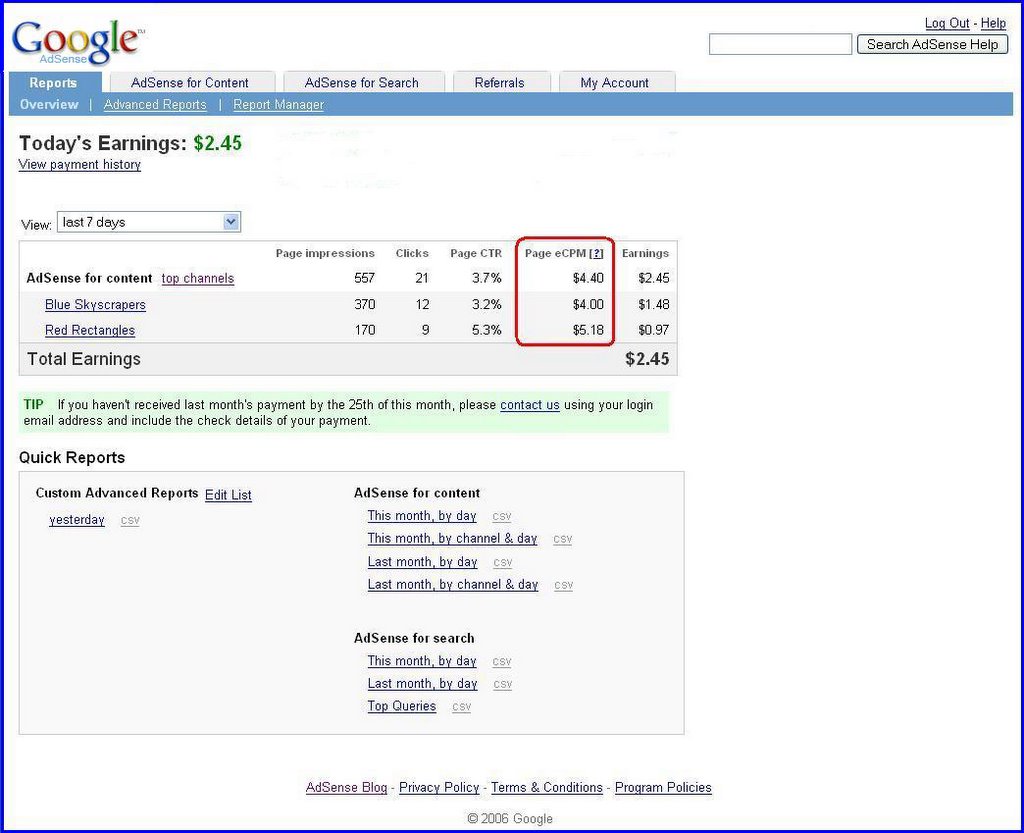
For example, let's imagine we have two custom channels named 'Blue Skyscrapers' and 'Red Rectangles', respectively, which reflect the types of ad formats we're testing on our site. During our test, the 'Blue Skyscrapers' channel receives 370 page impressions and $1.48 in total earnings. The 'Red Rectangles' channel receives 187 page impressions and $0.97 in earnings over the same period. To make these figures more comparable we calculate eCPM -- i.e., the estimated earnings for every 1,000 impressions received. We find that eCPM for blue skyscrapers is $4.00 while the eCPM for red rectangles is $5.18.

This means if we received 1,000 impressions of blue skyscrapers, we would earn roughly $4.00. But for 1,000 impressions of red rectangles, we would earn about $5.18. Therefore, assuming that our sample size is large enough, it is to our advantage to switch to red rectangles throughout our site because they generate more revenue per impression.