Showing posts with label Newbie. Show all posts

Tuesday, 24 October 2006

When AdSense met Blogger (in beta)

If you have a blog on the new version of Blogger in beta, we're happy to introduce you to the drag-and-drop AdSense widget! Using this new feature, you can easily add AdSense to your blog by following these instructions.

1. First, log into the new version of Blogger with your Google Account. Click on the Layout link next to the blog where you’d like to feature Google ads.

(If you don’t see the Layout option, it’s possible that your beta blog is still in the classic template -- visit your blog’s Template page and click Customize Design. You can then upgrade your blog to the new template in minutes.)


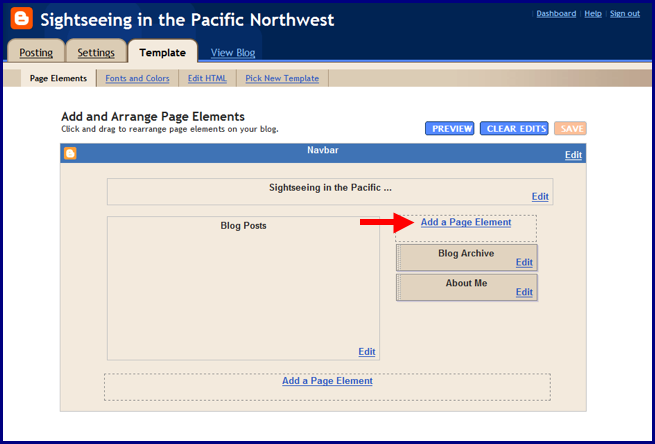
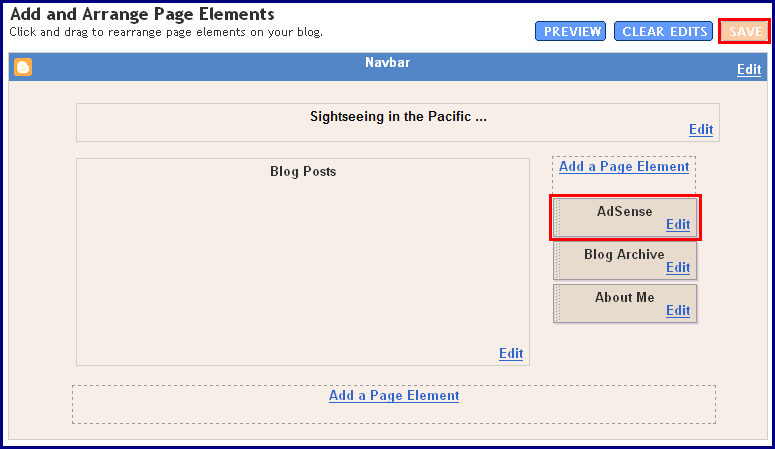
2. Next you should be taken to your Template – Page Elements page. Click on one of the Add a Page Element links shown below.


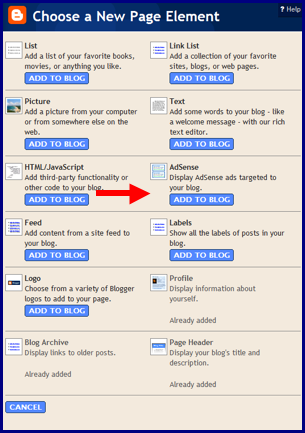
3. In the pop-up window, click the blue Add to Blog button underneath the AdSense option.


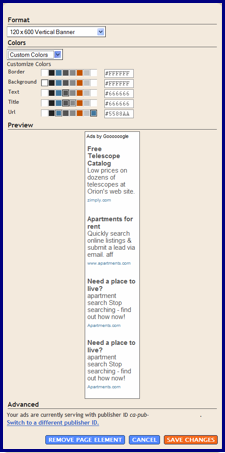
4. If you already have an AdSense account, simply sign in with your AdSense login; if not, you can create an account directly on this page. After signing in, you can select your preferred color template and ad format. When you're finished, click on the orange Save Changes button.


5. Now you can easily drag and drop your AdSense ad unit anywhere on your blog's template -- or delete it if you need to make changes. When you're all done, click the orange 'Save' button on the upper right corner and go view your new blog!


We hope you find this new feature helpful when implementing your ads. Let us know if you have any comments or suggestions.

Tuesday, 20 June 2006

Video mailbag: Theresa Chow answers your questions


Theresa discusses the following:

1. How many Google AdSense products can I use in each website?

2. How do I get rid of an ad that I don't want on my site? I have some disagreements with it.

3. In case we would like to add other websites, do we need to create another AdSense account?

UPDATED to provide summary of content

Wednesday, 3 May 2006

An 'AdSense Help'-ing hand

Since the AdSense Help Group launched, we noticed you've been having lots of interesting discussions about AdSense. We thought we'd address a couple questions that have come up fairly frequently in the Help Group.

My website tracking software is registering more impressions than my AdSense account -- why is there a discrepancy?

To provide more accurate information about ad performance, we count impressions only when the AdSense JavaScript is executed by a user's browser. Therefore, the impressions listed in your AdSense account may differ from statistics reported by third parties. For example, AdSense doesn't count impressions generated by:

  • Other spiders, robots, crawlers from other search engines

  • Browsers that don't have JavaScript enabled or don't support JavaScript

  • Browsers that don't support the iFrame tag

  • Programs that people may have written to grab website content


  • I pasted AdSense ad code for two ad units into my site -- why is only one ad unit appearing on my page?

    Don't worry, this is normal ad behavior designed to automatically optimize your site's revenue potential. Although you can display up to 3 ad units per page, sometimes only the first ad unit contains ads. When highly targeted ads aren't available for all your ad units, we'll display the additional ad units as transparent boxes rather than showing ads that our system determines would not perform well. As our ad inventory changes, or if your page content changes, you may start seeing ads appear in all of your ad units.

    In the meantime, you can set up your ad code so that an alternate ad will appear when this happens.

    Thursday, 13 April 2006

    Earnings: Your questions answered

    Is there is a minimum number of impressions or clicks I need to get before I can start earning through AdSense?

    No, there's no minimum number of impressions or clicks for generating earnings. You can start earning the very first time a user clicks on a cost-per-click (CPC) ad or views a cost-per-thousand-impressions (CPM) ad. Keep in mind, however, that you'll need to earn $100 before your earnings will be paid out to you.

    If a CPM ad appears on my site, do I need to receive 1,000 impressions before I am paid?

    No, with CPM ads you're paid for each impression, so if you receive 1 ad impression, you'll receive 1/1,000 of the CPM bid for that ad unit.

    I received 57 page impressions. Why don't I have any earnings?

    It sounds like the ads currently appearing on your site are probably CPC ads, so you'll be paid for clicks, rather than impressions. Our system will automatically display whichever ad or ads representing the highest revenue potential for you, whether they're CPC or CPM ads.

    How much do you pay per click or impression?

    We don't pay a fixed price for each click or impression - we pay you a portion of the amount paid by the AdWords advertiser. This amount varies based on the actual CPC or CPM paid by the advertiser. Each ad that appears on your site will most likely generate a different CPC or CPM.

    Do I get paid when visitors use my search box?

    With AdSense for search, you'll be paid when users click on the ads that appear on their search results pages, not from the search queries themselves. You won't be paid if a visitor uses your search box, but chooses not to click on the ads on the search results pages.

    Do I get paid when visitors click on my link unit topics?

    When a user clicks on a link unit topic, you'll be paid for clicks on the CPC ads that appear on the resulting page of highly targeted ads. However, you won't be paid for clicks on the initial topics themselves. Link units can siginficantly boost your overall AdSense revenue by providing even more relevant and monetized content to your users.

    Monday, 27 February 2006

    eCPM -- what exactly is that?

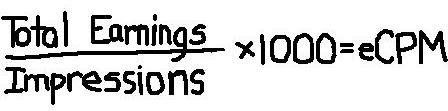
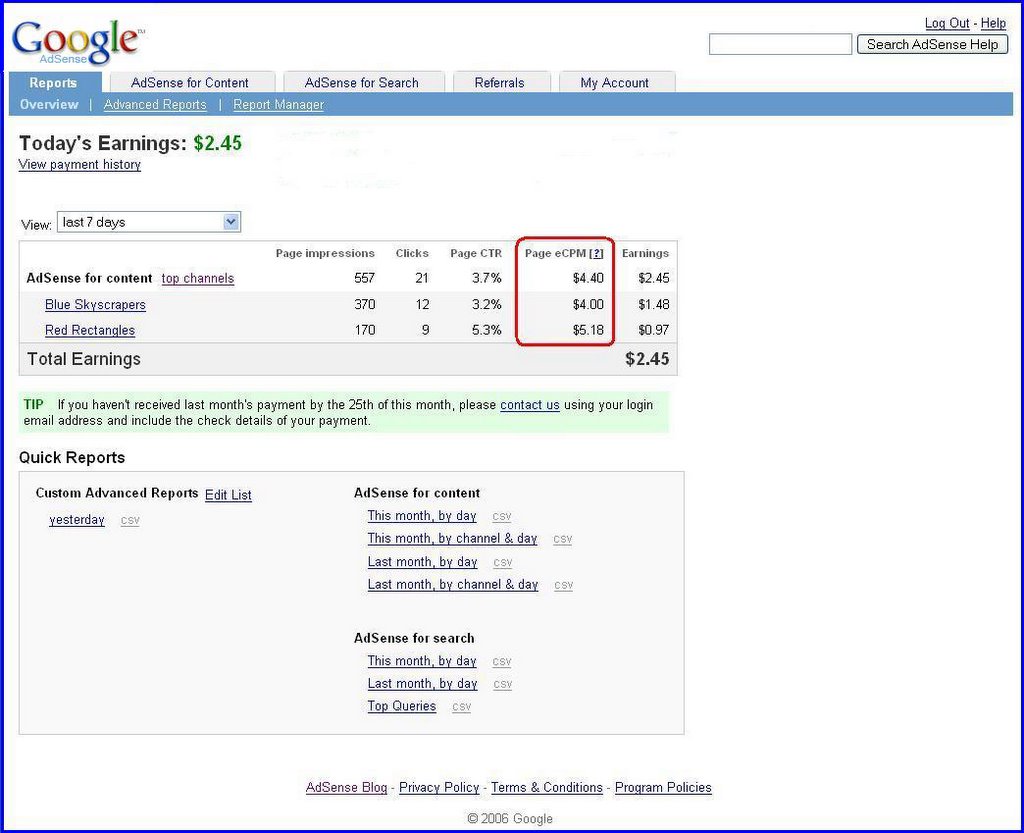
    eCPM is a bit of industry shorthand that seems here to stay. You've seen it listed in your AdSense reports; it means, "effective cost per thousand impressions." So how is eCPM calculated, you ask?


    eCPM is calculated by dividing total earnings by total number of impressions in thousands. It is a great performance measure for your various ad units, so when experimenting, you can use eCPM to compare your results.


    But what if your site doesn't receive enough impressions to have a large sample size? Even for smaller sites, eCPM can be a useful statistic to track ad performance.

    For example, let's imagine we have two custom channels named 'Blue Skyscrapers' and 'Red Rectangles', respectively, which reflect the types of ad formats we're testing on our site. During our test, the 'Blue Skyscrapers' channel receives 370 page impressions and $1.48 in total earnings. The 'Red Rectangles' channel receives 187 page impressions and $0.97 in earnings over the same period. To make these figures more comparable we calculate eCPM -- i.e., the estimated earnings for every 1,000 impressions received. We find that eCPM for blue skyscrapers is $4.00 while the eCPM for red rectangles is $5.18.

    This means if we received 1,000 impressions of blue skyscrapers, we would earn roughly $4.00. But for 1,000 impressions of red rectangles, we would earn about $5.18. Therefore, assuming that our sample size is large enough, it is to our advantage to switch to red rectangles throughout our site because they generate more revenue per impression.

    Thursday, 19 January 2006

    Nine for newbies

    Your AdSense application has just been approved, and you've got a world of new information to absorb. We've highlighted some key resources to answer all the questions you have about AdSense (but were afraid to ask).

    1. First, you can see our handy Quick Start guide to learn how to access your AdSense account and customize your ad code before pasting it into your site. For a more detailed walkthrough, see the Help with Ad Code demo.

    2. Once you've added the code to one website, you may want to add it to more of your sites or pages -- the ad code will work for any page or site.

    3. Once your ads are up and running, it's time to think about getting paid. The Payment Guide provides a broad overview of AdSense payments, or you can find more in-depth information by watching the Payment demo.

    4. If you start to see ads that you'd prefer not to display on your site, don't worry. You can prevent these ads from appearing on your site by using your Competitive Ad Filter list to block them.

    5. Are you having trouble with the ads on your site? You can use one of our troubleshooting wizards to sort out the issue, or browse our Help entry on Public Service Ads (PSA's).

    6. Familiarize yourself with other AdSense features and products to monetize your site even further: AdSense for search, referrals, and Onsite Advertiser Sign-up that can help you earn more revenue from your site.

    7. Concerned about keeping your account in good standing? You can review the program policies for a comprehensive list of do's and dont's or our ten suggestions to help ensure your account won't be disabled.

    8. Optimize! Our Optimization Tips will help you earn more and get the most revenue from your AdSense account.

    9. Acquaint yourself with the AdSense Help Center. It's the quickest way to get the answers you need at any time.

    Now you can get on the road to becoming a successful AdSense publisher...and start driving!