Tuesday, 17 October 2006

All the elements for a successful optimisation

Many of you might remember our April post featuring Ivan Heneghan, a member of the AdSense UK Optimisation Team. Ivan discussed a science website that was able to dramatically increase AdSense earnings through a few simple changes. Well, Ivan's back to share more details about that story with you:

When UK-based WebElements.com started using AdSense in late 2003, their earnings averaged out at a low daily rate. In January 2005, WebElements began to focus on optimisation, experimenting with different ad colors, ad styles, and page locations. They found success by adding link units to each page of their site, placing Large Rectangles directly before and after their content, and adding a Wide Skycraper to their left sidebar.
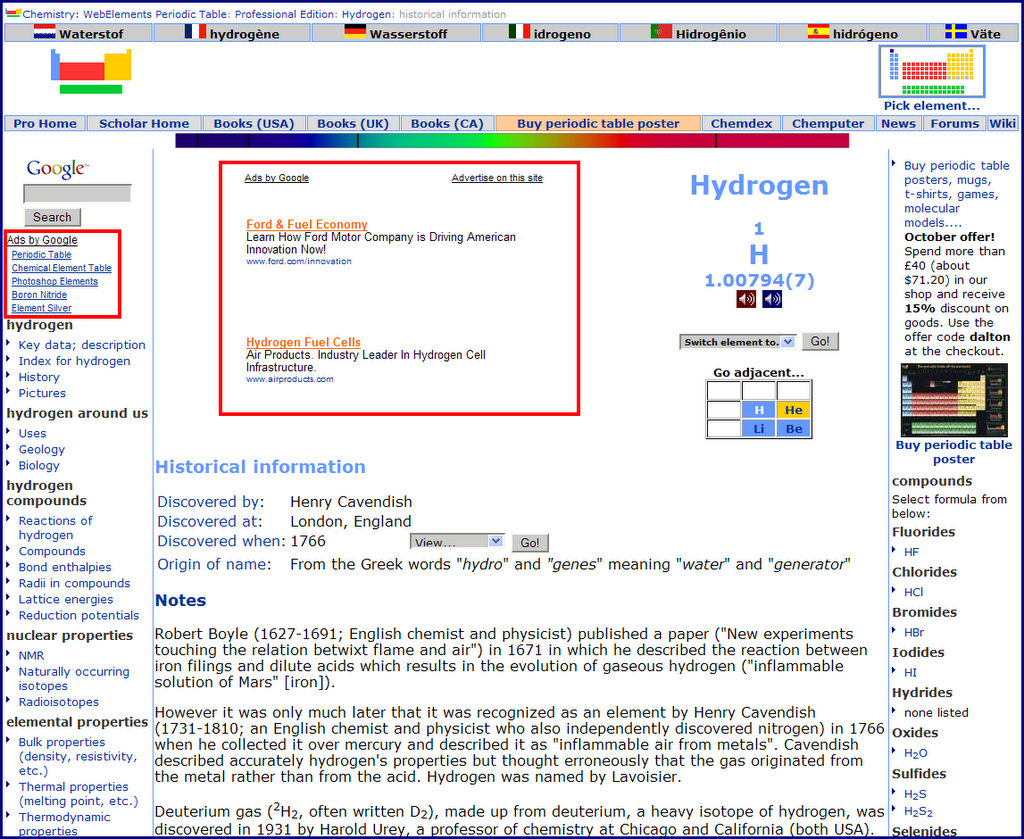


In the week following the optimisation, WebElements saw revenue increase by 500%. They then made other small placement changes to the site, which resulted in a spike doubling the revenue yet again -- as a result, the site was earning over 1000% its original earnings for some of the year.

Today, this ad revenue enables WebElements to further develop their site. The company advises that "it is important to experiment with colors, ad sizes, and locations on the page, as the audience for one type of web site may well respond to ads differently to another. It is worth experimenting with colors that blend with site design and others that show some contrast. It is also a good idea to use Adsense channels to run different color schemes in different channels at the same time and to wait for a week or so before deciding which colors work best. And, of course, content is king."

Thursday, 12 October 2006

Introducing multiple custom channels

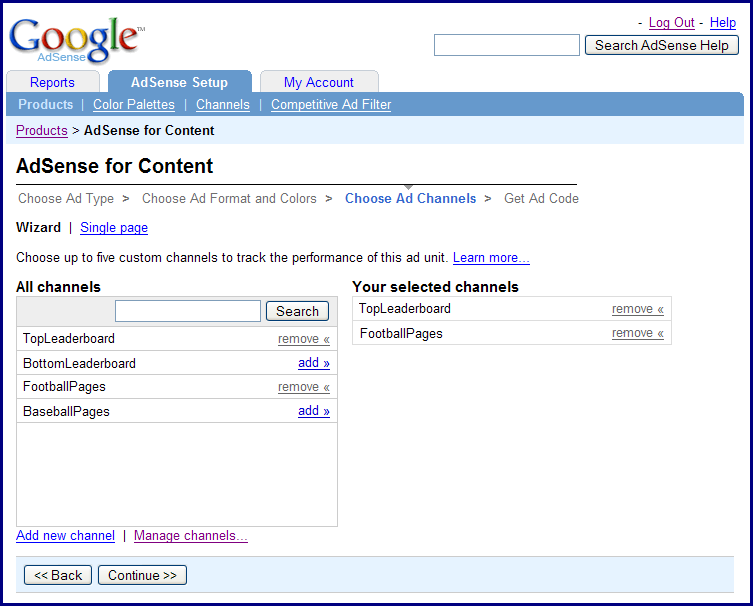
As of today, it is now possible to assign multiple custom channels to a single ad unit. This feature enables you to track your ad performance with greater flexibility and view more granular information. When generating your ad code, you'll be able to add up to 5 custom channels to a specific instance of ad code.


What's the benefit of tracking with more than one custom channel? Well, multiple channels can be very useful when you want to track one ad unit across several different metrics simultaneously. For example, let's say you run a sports website and you've placed a leaderboard at the top and bottom of every page. To track the performance of the ad placement, you've created two custom channels -- 'TopLeaderboard' and 'BottomLeaderboard' -- and regenerated your ad code appropriately.

But what if you also want to compare your football pages and your baseball pages at the same time? With multiple custom channels, this isn't a problem. Just create two new custom channels called 'FootballPages' and 'BaseballPages', and add them to the appropriate ad units. Now your leaderboards will each be tagged with two custom channels that let you know which position they're in (top or bottom), and the type of page on which they appear (football or baseball).

Please keep in mind that ad units tagged with multiple custom channels will log impressions or clicks in each channel. As a result, you'll see a higher number of impressions and clicks when you view your channel reports than when you view your aggregate reports.

If you'd like more information about setting up multiple channels, please visit our Help Center.

Wednesday, 11 October 2006

EFT available in three new countries

Are you a publisher located in the Czech Republic, Finland, or Slovakia? If so, we're happy to let you know that Electronic Funds Transfer (EFT) is now available to you. Sign up today to receive future payments directly in your bank account -- remember, the 15th of any month is the deadline to update your form of payment for that month's payment cycle. If you're having difficulty receiving your test deposit, you might find our troubleshooting tips useful.

Tuesday, 10 October 2006

Go go Google Gadgets

Wouldn't it be great to get your content in front of people while they're visiting Google.com or other webpages? More eyeballs on your site means more opportunities for your content to reach visitors, along with, of course, your AdSense ads. Google Gadgets enables you to do just that.

Gadgets are miniature devices that offer cool, dynamic content ranging from games to news clips to weather reports to just about anything you can dream up. They've been around for a while, but their reach got a lot broader last week when we made it possible for anyone to add gadgets to their own webpages. That means you! Here's an example of a flight status tracker, for instance, that can be placed on any page on the web.


You can search for free gadgets to add to your own webpages in our directory of gadgets for your webpage. To display a gadget, just pick the one you like, set your preferences, click "Get code," and copy-and-paste the HTML onto your own page. Add some 'bling' to your site and 'wow' your readers!

Creating Google Gadgets from your own content for others to use isn't hard, either -- anyone with even a bit of web design experience can make a simple one in HTML, and more advanced programmers can create really snazzy complex applications. But remember, it’s also quick and easy for people to delete gadgets and add new ones to their own pages. To help you make sure your gadget will be popular across the web, we provide a few guidelines to keep in mind. The more valuable visitors find your content, the longer they'll keep your gadget on their pages, the more often they’ll visit your site -- and the better that can be for your AdSense performance.

Here are a few other suggestions for successfully distributing your own content on the Google homepage or other pages across the web:
  • If your website has a feed, visitors can put snippets of your content on their own Google homepages quickly and easily -- you won't even need to develop a gadget. However, you'll be able to customize your visitors' experience much more with a gadget than with a feed.

  • By putting the "Add to Google" button in a prominent spot on your site, you can increase the reach of your content, because visitors who click to add your gadget or feed to Google can see your content each time they visit the Google homepage. Promoting your own gadget or feed can also increase its popularity, which contributes to a higher ranking in the Google personalized homepage directory.

Thursday, 5 October 2006

Forums? For me?

At the beginning of September, we announced that AdSense Help Forums were available in English, German, and Chinese. We’re happy to add two more forums to that list: AdSense ヘルプ フォーラム for our Japanese-speaking publishers, and Fórum do AdSense for our Portuguese-speaking publishers.

Are you looking for advice on how to set up your channels or optimize your site? Would you like to ask other publishers who live in your region how long it usually takes them to receive their checks? If you'd like to discuss anything AdSense, our Help Forums are the place to be -- visit today to post your questions!

Wednesday, 4 October 2006

The missing link

Even if your site is well-designed, with colors that look great and ad formats that your users respond well to, you still might hear a nagging voice inside your head that says, "There must be more I can do!" If this sounds familiar, then we've got a cure -- link units work wonders when you're looking for additional ways to give your AdSense performance a pick-me-up. They offer your users fresh, new content and can be customized and tracked just like standard text ads.

If the voice in your head is still there, it's likely asking, "Where should I place link units on my pages?" Here are some ideas to get the ball rolling:
  • Above or below a navigation menu or site search box -- but remember to keep your link units distinct
  • Above the fold, at the beginning of pages with more focused content where people may be seeking specific information (article pages, category-level pages)
  • In prime spots as designated by our heat map
Looking for more ideas? Our link unit example page might help.


Link units proved to be the missing link for several of our publishers- you might remember reading about how Engineeringtalk, Ask The Builder, and PCFreunde saw their AdSense earnings soar after adding link units to their pages.

With 12 different sizes, you're bound to find a size that fits snugly into those "hard to reach" areas of your site.

Tuesday, 3 October 2006

Spotlight on... TakeABreak.com.au

To continue the Australian theme from last week's post, we'd like to share a recent case study which focuses on an Australian publisher. Craig Davis, General Manager of TakeABreak.com.au, saw an increase of 30% in his AdSense revenue after he changed his layouts and introduced image ads. Now, AdSense revenue makes up about 10% of his company's overall revenue. Craig noted that AdSense was "a key element that helped us to move quickly from just another start-up to a leader in the online accommodation industry."

Read more about Craig's story here.