Tuesday, 31 January 2006

Meet our AdSense engineers: Juliana

Like Dorothy in the Wizard of Oz, we're all curious about who's responsible for the magic that takes place behind the curtain. Through our series of interviews with members of our engineering team, we hope you'll gain a little insight into the men and women behind the AdSense engineering wizardry. This Q&A is with Juliana.

Which AdSense projects or features have you worked on?

In the past few months, I have worked mostly (but not exclusively) on custom reports, emailable reports, and the general reporting engine.


What's your area of technical expertise?

Just like many other Googlers, I am pretty flexible about the projects that I work on. I have worked in the area of mathematical programming, virtual webhosting, control centre for various services, and java programming for high volume web applications.


What is the most challenging aspect of working for AdSense?

The flexibility that I have in deciding how to code and design our new features is challenging -- it makes the problem much more complex. It's also what I like most about working for AdSense because it provides room for creativity. People here really appreciate your thoughts, so I have a say in what should go into the final product.


What advice would you give publishers?

We like being able to help our publishers. Please keep the feedback coming.


What are your favorite websites?

Apart from Google, which I really do use all the time, I like petfinder.com, where I found my dog, and doghobbyist.com. I also like nytimes.com and cnn.com for staying current with news.


Tell us an interesting fact about yourself.

I have Newton, a sweet golden retriever mix who comes to work with me every day. He was rescued from the shelter two years ago. He sleeps in a puppy bed under my desk. Many people at Google like him and there are some people who regularly visit my office to play with him.


If you were an animal cracker, which one would you be and why?

Too bad we don't have a puppy dog in the solution space :) Given that constraint, I will choose to be the teddy bear. It is close enough.

Monday, 30 January 2006

Blogtimize!

Blogging is near and dear to our hearts here at Inside AdSense. We know you want to get the most out of those posts – but how do you do it?

1. Choose the right ad formats

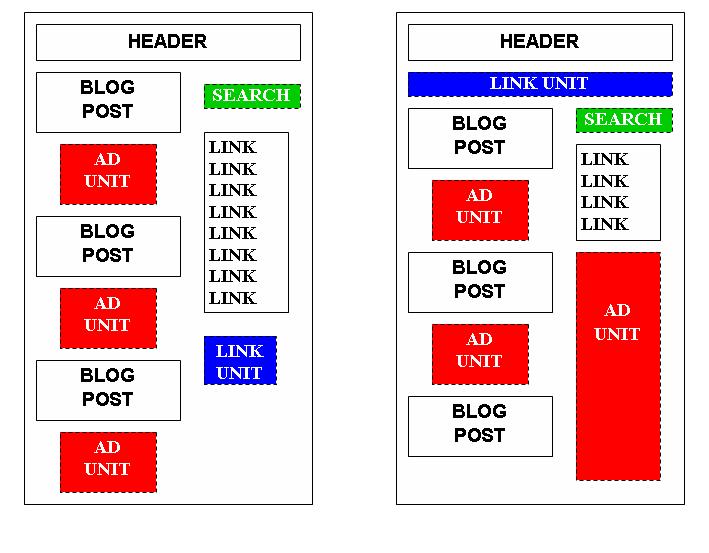
Because the typical blog layout uses a narrow section for posts, the medium rectangle fits nicely at the end of each post. The medium rectangle also supports image ads, increasing the competition and revenue potential for that ad space. For shorter posts, a banner may be a better fit.

2. Place ads where your readers will notice

Blog main page:

Whether the subject is gadgets, gossip, or a glimpse into the writer's personal life, readers are deeply engaged with the content of their favorite blogs. What could be more effective than displaying an ad precisely relevant to that content? An ad after each post can serve as a "commercial break" from reading or as an "action step" to take after reading.

Individual blog entries:

As individual post pages don't have a lot of content, the key is to place ads near your content without bombarding the page with ads. For long entries, try embedding a blended medium rectangle into your post and adding a banner at the end. For short entries, just place one medium rectangle or banner at the end.

If there's a comment section after the post, place a banner or a horizontal link unit just above the comment box. Rather than using the traditional Skyscraper in your sidebar, consider using a link unit, which will offer a wider range of topics and may appear less obtrusive.

3. Improve targeting

How can you ensure that your ads are relevant to a specific post? With section targeting, you can target an ad unit to a specific section of the page, as well as block out irrelevant sections such as the navigational links.

4. Customize your ad colors

For more seamless integration with the content, blend ad units into the background of your blog. Choose a bold color for the ad title to help draw attention to your ads while ensuring that users don't confuse ads with content.


With up to three ad units, one link unit, and one search box on every page, layout options abound! While the suggestions above offer some guidance, you should experiment with different ad unit-link unit-search box combinations on your pages, keeping your particular users' experience in mind when it comes to placement. Most importantly, use custom channels to see what performs most effectively for your site.

Do you have a "blogtimization" success story? Email us to let us know what worked for you.

Thursday, 26 January 2006

Name that account

If you receive payments by EFT, you can now keep track of all of your different bank accounts by giving each an 'Account Nickname.' You're welcome to add the name of the bank or any other easy-to-remember name so that, at the end of the month, you'll know exactly which bank account to go to for your AdSense payment. The payment should be in your bank account by the 5th of the following month.

To create an account nickname, go to the Account Settings page of your account and click 'Edit' in the Payment details section. Continue to choose EFT as your form of payment, and you'll be prompted to provide your bank account information, along with an Account Nickname. Choose a name that'll jog your memory in the future, and you'll be set to go.

Monday, 23 January 2006

Color your ads beautiful

Your AdSense ad units should complement your overall site design, not detract from the user experience. Ad units that mirror the look and feel of your site can surprisingly increase the effectiveness of your ads. Blending ad colors into the background of your site can soften ad appearance and combat ad blindness, while the 'Ads by Goooooogle' branding distinguishes AdSense ad units from your site content.

Simply matching the background color to the area of site implementation can help increase click-through rate. We recommend creating a custom color palette theme on your site to accentuate title, information text, and URL color. For example, say your site has a white background, black borders and grey text. When generating your ad code on the 'Ad Layout' page of your account, you might customize your color palette to use white borders, a white background, black headings and grey text when generating your ad code.


UPDATED for accuracy.

Friday, 20 January 2006

Let your ads be seen

As anyone who's ever had stage fright knows, there are times it would be great to be invisible. But while people sometimes feel bashful in the public eye, Google ads tend to perform best when they're easily seen. Increasing ad unit presence on your site and placing ads 'above the fold' (i.e., the area visible on a page without scrolling down) can enhance the likelihood that people will see and respond to your ads.

As a general rule of thumb, ideal ad placement lies in a region balancing the left to right (emphasis towards the left), and top to bottom (emphasis towards the top) portion of a page. Article based pages are an exception, as placing ads directly below an article can lead to a greater number of readers clicking through.

The number of ad units you choose to display can also affect ad performance. While some sites perform well using the maximum 3 ad units per page, it's important to maintain a balance between content and ad display -- the optimal number of ad units per page varies for different sites.

Lastly, remember that custom channels are helpful in the testing process to track ad unit performance. By using channels, you can collect 'before' and 'after' data to help you measure the effects of different ad placements.

Thursday, 19 January 2006

Nine for newbies

Your AdSense application has just been approved, and you've got a world of new information to absorb. We've highlighted some key resources to answer all the questions you have about AdSense (but were afraid to ask).

1. First, you can see our handy Quick Start guide to learn how to access your AdSense account and customize your ad code before pasting it into your site. For a more detailed walkthrough, see the Help with Ad Code demo.

2. Once you've added the code to one website, you may want to add it to more of your sites or pages -- the ad code will work for any page or site.

3. Once your ads are up and running, it's time to think about getting paid. The Payment Guide provides a broad overview of AdSense payments, or you can find more in-depth information by watching the Payment demo.

4. If you start to see ads that you'd prefer not to display on your site, don't worry. You can prevent these ads from appearing on your site by using your Competitive Ad Filter list to block them.

5. Are you having trouble with the ads on your site? You can use one of our troubleshooting wizards to sort out the issue, or browse our Help entry on Public Service Ads (PSA's).

6. Familiarize yourself with other AdSense features and products to monetize your site even further: AdSense for search, referrals, and Onsite Advertiser Sign-up that can help you earn more revenue from your site.

7. Concerned about keeping your account in good standing? You can review the program policies for a comprehensive list of do's and dont's or our ten suggestions to help ensure your account won't be disabled.

8. Optimize! Our Optimization Tips will help you earn more and get the most revenue from your AdSense account.

9. Acquaint yourself with the AdSense Help Center. It's the quickest way to get the answers you need at any time.

Now you can get on the road to becoming a successful AdSense publisher...and start driving!

Tuesday, 17 January 2006

From the mail bag

Malcolm asks: I have noticed that the number of ads displayed in my large rectangle ads has dropped form 4 to 2 ads. Do you know why this is?

We say: It sounds like you're seeing expanded text ads appearing on your site. Our technology optimizes the number of ads per ad unit to ensure your site's revenue potential is maximized. When AdSense determines that fewer ads will perform better in a particular ad unit, the lower paying ads are automatically dropped.


Carmen asks: My webhost is not compatible with JavaScript. Is there still a way I can participate in AdSense?

We say: Of course! You can place the AdSense ad code and search code on any page on any site that complies with our program policies. However, if you don't have a website, or your site isn't compatible with Javascript, you can create a new site using Google's weblog service, Blogger. Signing up for a Blogger account is fast, easy and free.

Once you've created your site, you can begin displaying Google ads in minutes by following the step-by-step instructions listed on the Blogger help pages.


David asks: My application to AdSense was initially disapproved due to an error in my contact information. I have since fixed this error, resubmitted my application, and was approved today. However, I am seeing a 'you are not authorized to view this web page' error message in my ad units and search results page.

We say: Don't worry -- since your application was previously disapproved, the servers may not have caught up with your more recent information, which is why you are seeing the error message. While our servers are being informed of the change to your account status, there may be a delay before Google ads and AdSense for search results start to appear. Ads usually start to appear within 48 hours.


Alastair asks: How much time does it take for my reports to update?

We say: AdSense reports are usually updated every 15-30 minutes, but sometimes there can be a longer delay before your reports are fully updated. Even if you notice a delay in your account reporting, fear not -- your stats are still being tracked and you'll be paid for all valid clicks and impressions.