As you might already know, a great way to increase your AdSense earnings is to place multiple ad units on webpages that are rich with content. Here's a way to maximize your revenue with multiple ad units: Make sure the ad unit with the highest CTR is the first ad unit in the HTML code of your page. We've heard that there may be some confusion on this, so here's some clarification on how we serve ads to a page once we know which ads win the auction.
Currently, the first ad unit on a page always shows the top ads that win the ad auction. Also, if there aren't enough ads in our ad inventory to fill all of the ad units on a page, the first ad unit on the page will display ads first. This is why I recommend using custom channels to determine which of your ad units has the highest CTR, and then placing that ad unit first in the HTML code.
For the purposes of this post, the first ad unit on the page is defined as the first instance of the ad code within the HTML of the page. Keep in mind that the first ad unit in the source code is not always the first ad unit that your users will see when the page finishes loading in their browser. For example, if you use DIV tags, our system may recognize an ad unit which users see at the bottom of the page as the first ad unit.
Now that you know how to make the most out of multiple ad units, try this tip and watch your earnings grow.
Showing posts with label Optimization. Show all posts
Showing posts with label Optimization. Show all posts
Thursday, 2 November 2006

Thursday, 31 August 2006
"Augtomize" year-round
It's hard to believe the month is already over. It seems like just yesterday when Mike Gutner first announced that August was Optimization Month. Since then, members of the AdSense optimization team and Googlers representing other products have shared their findings and best practices for how to optimize your AdSense earnings. We hope you've come through the month with an arsenal of insightful tips and tricks for optimizing not only your AdSense ads, but also your site content for your specific audience.
We'd like to leave you with the following:
We'd like to leave you with the following:
- Nothing warms the hearts of our team more than hearing success stories from AdSense publishers. Please tell us yours!
- The road to enlightenment begins with the Optimization Tips page. If you haven't seen it yet or it's been awhile, be sure to check it out.
- Teach a person to fish, and you feed them for a lifetime. The AdSense Help group is a great community to post optimization tips and swap best practices with other publishers.
Wednesday, 30 August 2006
Robert's tips for the future
 If you've taken the time to make changes to your site over the past month, it's important to monitor their effects. Here are my top three tips to ensure you make the most of measuring your results and gain a deeper understanding of what's happening with AdSense on your site.
1. Get accustomed to custom channels.
The single most effective way I've found for publishers to measure their results is by using custom channels. Custom channels are the ideal way to determine how a recent change in ad placement or ad format has resulted in improved performance. Many publishers fail to keep their custom channel list up to date each time they make a change -- or even worse, don't take the time to set them up at all. Not knowing if you've made the right decision for your site's visitors will make it even more difficult to take the next step, so use custom channels like a tracking device to ensure you're on the road to success.
2. Be analytical in your approach -- use Google Analytics.
Monitoring your AdSense performance need not be restricted to the features within your AdSense account. Learning about where your visitors come from and how they interact with your website will help you make informed decisions regarding ad placement and formats. As we mentioned last week, Google Analytics can help you make choices about improving your site design while incorporating the Adsense optimisation tips into your new layout. Measuring the results of such changes enables better decisions for your site's users, so why not measure your site performance with Analytics?
3. Make yourself available, your reports are now emailable.
If you're serious about measuring how your account is performing, you'll need to keep up to date with your reports. Why spend time trawling through data in your account when you can get it all sent directly to your inbox? Emailable reports are a recent addition to your AdSense account, which give you exactly the data you're interested in on a daily, weekly or monthly basis. What's more, you can send them to multiple email addresses. This way, you can keep your business partner up to date on recent successes. Emailable reports are easy to set up and even easier to access, with one click in your inbox. If you're not using this option already, I encourage you to to set up emailable reports today to monitor the effects of your changes straight away.
Tuesday, 29 August 2006
Back to school basics
The “back to school” buzz is in the air, and just as it was key to organize your papers in middle school using your trusty Trapper Keeper, it’s important to manage your ads using your AdSense data. Doing so lets you to see the effectiveness of the different implementations you’ve tested out this month and make decisions about next steps. So let’s flash back to the good old days and apply what we learned in middle school.
Vocabulary: Understanding your data
Before you could use a new word from your vocabulary textbook, you needed to understand its definition. Similarly, there are several important statistical values on your Advanced Reports page for which you should know the definitions before doing any analysis. I recommend that you check out our glossary for each of the terms (Page Impression, eCPM, Clicks) to understand how these values are affected by the changes you make to your site.
Foreign languages: Translating your data
Learning a foreign language involves taking a great deal of new information and breaking it down into sizeable chunks to interpret it. As we mentioned in a previous post, URL and custom channels are a great way to take a more granular look at your site and track specific implementation changes you’ve made.
It’s also necessary to create an appropriate measurement for your data. Too much is confusing, and too little is not going to give you accurate results. Normally, good measurements include 30-, 60- and 90-day increments.
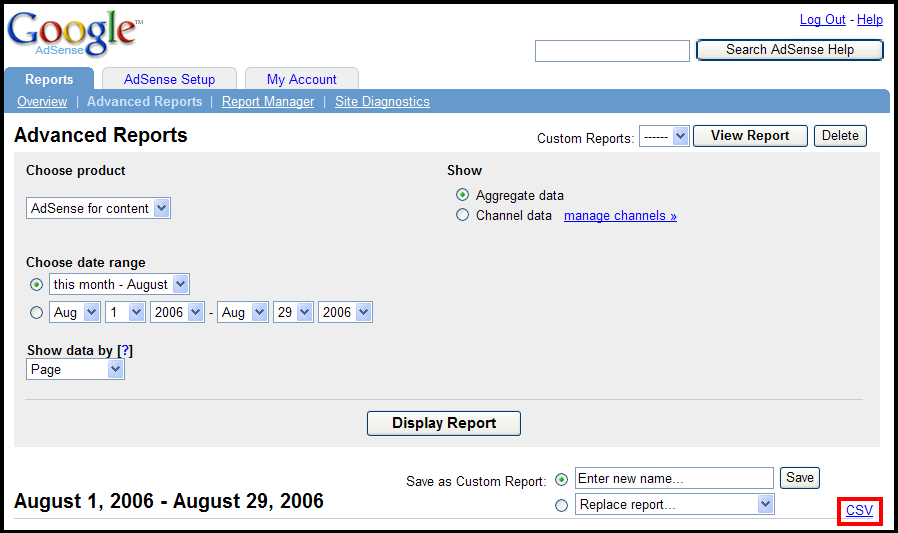
Finally, you’ll need to analyze the data. A great feature we offer is the CSV link, which enables you to download your data onto your hard drive so you can rearrange it to your specific needs. I recommend using Google Spreadsheets or Excel.

Art appreciation: Displaying your data
As your art teacher used to say, a picture is worth a thousand words. Staring at raw data can be tedious and won't help you visualize trends in your AdSense stats. This is why tables and graphs are so effective. A table can make your data more comprehensive and easier to read, while a graph helps you to observe visually what's happening to your various values. If you notice that one channel is performing better than another over a set period, it may be time to implement the same changes into your other pages.
Tip: Track the various implementation changes you’ve made on a separate sheet, and note the date. You can then review those dates later and compare them with previous sets of data to discover which changes had the greatest impact on your site.
Quarterly report card
I recommend that you perform this type of analysis every 3 months to ensure that you are optimizing your site to its potential. By tracking and managing your data, you will be on your way to becoming a more savvy AdSense user. And of course, don’t forget to thank your 7th grade teacher for imparting this knowledge.
Vocabulary: Understanding your data
Before you could use a new word from your vocabulary textbook, you needed to understand its definition. Similarly, there are several important statistical values on your Advanced Reports page for which you should know the definitions before doing any analysis. I recommend that you check out our glossary for each of the terms (Page Impression, eCPM, Clicks) to understand how these values are affected by the changes you make to your site.
Foreign languages: Translating your data
Learning a foreign language involves taking a great deal of new information and breaking it down into sizeable chunks to interpret it. As we mentioned in a previous post, URL and custom channels are a great way to take a more granular look at your site and track specific implementation changes you’ve made.
It’s also necessary to create an appropriate measurement for your data. Too much is confusing, and too little is not going to give you accurate results. Normally, good measurements include 30-, 60- and 90-day increments.
Finally, you’ll need to analyze the data. A great feature we offer is the CSV link, which enables you to download your data onto your hard drive so you can rearrange it to your specific needs. I recommend using Google Spreadsheets or Excel.
Art appreciation: Displaying your data
As your art teacher used to say, a picture is worth a thousand words. Staring at raw data can be tedious and won't help you visualize trends in your AdSense stats. This is why tables and graphs are so effective. A table can make your data more comprehensive and easier to read, while a graph helps you to observe visually what's happening to your various values. If you notice that one channel is performing better than another over a set period, it may be time to implement the same changes into your other pages.
Tip: Track the various implementation changes you’ve made on a separate sheet, and note the date. You can then review those dates later and compare them with previous sets of data to discover which changes had the greatest impact on your site.
Quarterly report card
I recommend that you perform this type of analysis every 3 months to ensure that you are optimizing your site to its potential. By tracking and managing your data, you will be on your way to becoming a more savvy AdSense user. And of course, don’t forget to thank your 7th grade teacher for imparting this knowledge.
Monday, 28 August 2006
Optimization Month, Week 5: Putting it all together
 So you’ve optimized your pages and implemented our best practices. Now what? It’s time to take a look at your results and decide where to go from here. To close out Optimization Month, this week we’ll share tips on how to monitor the performance of your account, how to evaluate your results -- and how to figure out what to do next.
Now that you’ve implemented some of our optimization tips and best practices, hopefully your revenue is on the rise. But what if you see ups and downs in your stats? Never fear -- it’s quite common for revenue to fluctuate over time for any number of reasons, like which ads your users click on, or changes in ad inventory.
Seasonality can also affect revenue. If you run a fan site for a TV show, you might see a drop in revenue after the season finale due to a reduction in advertiser inventory or a decrease in the number of site targeting campaigns. Or, if you run an education site, you may see revenue decline during the summer vacation due to decreased page views. This is completely normal, and things will bounce back.
It’s crucial to keep these normal cyclical changes in mind when evaluating your stats. It’s also important to compare apples to apples. For instance, be sure you’re comparing days or months that received a similar number of page views. This will ensure that you are making accurate data comparisons. Using custom channels will also help you compare ad unit statistics at a very granular level to determine exactly which units are performing well, and which need to be modified or moved in order to boost CTR and eCPM.
Finally, if you’re interested in learning more about innovative strategies other successful publishers have used, check out some of our case studies.
Remember that every site is unique, so it’s critically important to keep testing and experimenting to see what performs the best for your own site. Don’t be afraid to try new things! And finally, I leave you with the following words of wisdom: Duct tape is like The Force -- it has a Light side and a Dark side and it holds the universe together.
Thursday, 24 August 2006
Google Analytics hearts AdSense publishers
As an AdSense publisher, you've probably put a lot of effort into making your website the best it can be -- optimizing your ads, building good content, and driving high quality visits. But there's one crucial step left: to see just how effective these things are. How many visitors are you getting each day? What pages are they visiting? Where do they come from, and which keywords brought them to your site -- both from pay-per-click efforts and from natural search?
Many website owners push their site live, and then leave it at that, remaining in the dark about all these questions. Google Analytics can enlighten you. We think it's much more fun to have the answers to these burning questions, and that you owe it to yourself to know for sure. After all, this is the payoff for all the hard work that's gone into creating your site. When you launch or make a change to it, there's that initial excitement of wondering who's going to check it out. And Google Analytics can help you with all of this.

It's as easy to set up as AdSense. All you need to do is add a couple lines of code to each page in your site, and to gain valuable insight with graphical representations of visitor levels and detailed, easy-to-use reports that show:
Happy tracking!
Many website owners push their site live, and then leave it at that, remaining in the dark about all these questions. Google Analytics can enlighten you. We think it's much more fun to have the answers to these burning questions, and that you owe it to yourself to know for sure. After all, this is the payoff for all the hard work that's gone into creating your site. When you launch or make a change to it, there's that initial excitement of wondering who's going to check it out. And Google Analytics can help you with all of this.

It's as easy to set up as AdSense. All you need to do is add a couple lines of code to each page in your site, and to gain valuable insight with graphical representations of visitor levels and detailed, easy-to-use reports that show:
- pageviews of each of individual web pages
- the average time spent on each page
- new vs. returning visitors
- visitors' geographical location and language
- their browser and platform choices
- click path data
Happy tracking!
Wednesday, 23 August 2006
Just a click away
You're an AdSense publisher, and you've got great content, but you want a) more people to know about it and b) your loyal readers to know when you post new content so they can visit your site easily -- maybe by the click of a button. By building up traffic, you can get more eyeballs on your content and of course your AdSense ads. This is where Google Toolbar comes in.
There's more to Toolbar than just web search, pop-up blocking and auto-filling web forms. With the recent release of Google Toolbar 4, millions of Toolbar users are now adding custom buttons directly to their browsers. You can help users visit your site (and more) with just a click.

By adding your website's custom button to the Google Toolbar, people can instantly:
There's more to Toolbar than just web search, pop-up blocking and auto-filling web forms. With the recent release of Google Toolbar 4, millions of Toolbar users are now adding custom buttons directly to their browsers. You can help users visit your site (and more) with just a click.

By adding your website's custom button to the Google Toolbar, people can instantly:
- Visit your website
- Search your website by entering a query into the Google search box and clicking your custom button
- Get the latest feeds from your website by clicking the drop-down menu next to your custom button
Tuesday, 22 August 2006
Be webmaster of your domain (or sub-domain)
If a tree falls in the forest and no one can hear it, does it make a sound? Even more perplexing: if you have a great, content-rich website and nobody visits it, is the content useful? Rather than debate this, I'd like to share with you five ways that Google webmaster tools can help you drive more users to your site and improve the visibility of the site content you've worked so hard to create.
1. Submit all of your pages to the Google index – for free.
By using Google Sitemaps to submit your URLs, you help Google's web crawler do a more complete and efficient job of crawling your site. Sitemaps enables you to submit all of your pages to the Google index, and it's particularly useful for making sure that we know about all dynamically generated URLs or pages that are not adequately linked to on your site. But please note: submitting a Sitemap will not guarantee inclusion or influence your PageRank, and isn't a replacement for creating compelling and useful content.
2. Find out how Google sees your site.
Once you've made sure we have access to your site, you can see the common words used to link to your pages and that are seen by Google. This allows you to see trends in your site's content, and can help you determine why you may be ranking for particular keywords. You can also see which page has the highest PageRank by month. Some site owners are surprised to find that this isn't always the home page. If an internal page has the highest PageRank, you might consider spending more time optimizing the ads there.
3. Diagnose potential problems.
We let you know if, and why, we're having trouble accessing your site or specific pages. If we can't crawl a page, we can't index it -- so fixing any errors we list can help improve your overall coverage. If the AdSense Site Diagnostics tool shows that you're blocking pages from MediaPartners-Google (the AdSense crawler), you can use the robots.txt analysis tool of Google webmaster tools to test changes to that file and make sure those changes allow access. You can also see what pages you are blocking from other Google bots -- this lets you experiment with changes to see how they would affect the crawl of your site.
4. Find out which queries drive traffic to your site.
Using Google webmaster tools, learn which Google queries created clickthroughs to your site and where you were positioned in the search results for that query. You can also view data for individual properties and countries as well. For instance, you can see the queries from users searching Google Images in the United States that returned your site in the results. You’ll only see properties and countries for which your site has data.

5. Get re-included.
If your site has disappeared from the search results, read through the Google quality guidelines, then correct any problems on your site and request re-inclusion from your Google webmaster tools account. Please keep in mind that the reinclusion request form is only available to people using Google webmaster tools.
There's more.
Google webmaster tools are evolving, and we frequently add more features. Stay up to date on the newest features with the Google Webmaster Central blog and get your questions answered on the Google Webmaster Help discussion group.
Here's to building a loyal following for your website and, in turn, optimizing your AdSense earnings!
1. Submit all of your pages to the Google index – for free.
By using Google Sitemaps to submit your URLs, you help Google's web crawler do a more complete and efficient job of crawling your site. Sitemaps enables you to submit all of your pages to the Google index, and it's particularly useful for making sure that we know about all dynamically generated URLs or pages that are not adequately linked to on your site. But please note: submitting a Sitemap will not guarantee inclusion or influence your PageRank, and isn't a replacement for creating compelling and useful content.
2. Find out how Google sees your site.
Once you've made sure we have access to your site, you can see the common words used to link to your pages and that are seen by Google. This allows you to see trends in your site's content, and can help you determine why you may be ranking for particular keywords. You can also see which page has the highest PageRank by month. Some site owners are surprised to find that this isn't always the home page. If an internal page has the highest PageRank, you might consider spending more time optimizing the ads there.
3. Diagnose potential problems.
We let you know if, and why, we're having trouble accessing your site or specific pages. If we can't crawl a page, we can't index it -- so fixing any errors we list can help improve your overall coverage. If the AdSense Site Diagnostics tool shows that you're blocking pages from MediaPartners-Google (the AdSense crawler), you can use the robots.txt analysis tool of Google webmaster tools to test changes to that file and make sure those changes allow access. You can also see what pages you are blocking from other Google bots -- this lets you experiment with changes to see how they would affect the crawl of your site.
4. Find out which queries drive traffic to your site.
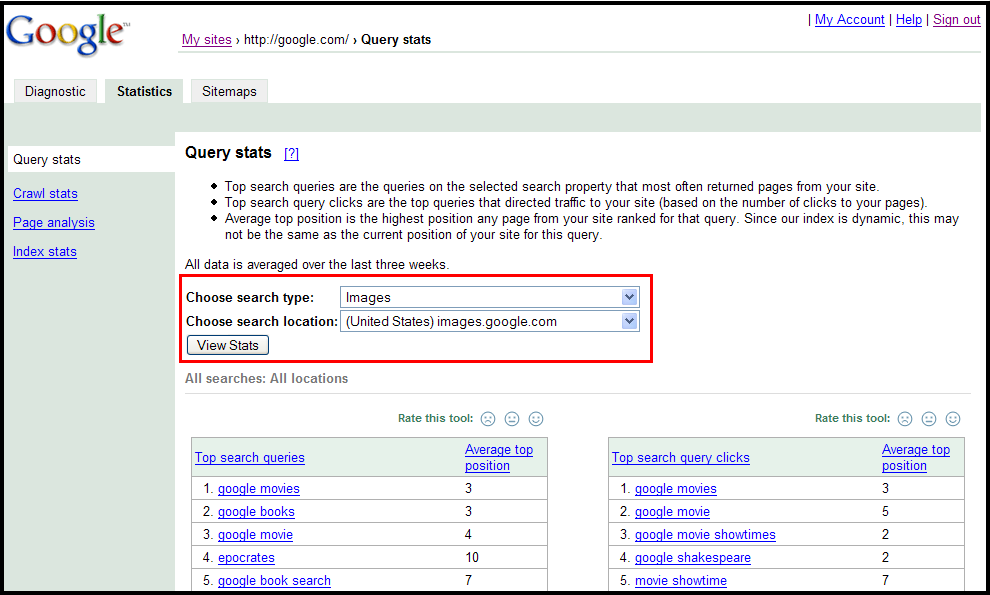
Using Google webmaster tools, learn which Google queries created clickthroughs to your site and where you were positioned in the search results for that query. You can also view data for individual properties and countries as well. For instance, you can see the queries from users searching Google Images in the United States that returned your site in the results. You’ll only see properties and countries for which your site has data.
5. Get re-included.
If your site has disappeared from the search results, read through the Google quality guidelines, then correct any problems on your site and request re-inclusion from your Google webmaster tools account. Please keep in mind that the reinclusion request form is only available to people using Google webmaster tools.
There's more.
Google webmaster tools are evolving, and we frequently add more features. Stay up to date on the newest features with the Google Webmaster Central blog and get your questions answered on the Google Webmaster Help discussion group.
Here's to building a loyal following for your website and, in turn, optimizing your AdSense earnings!
Monday, 21 August 2006
Optimization Month, Week 4: Building and understanding your audience
 If you've been following this blog for the past three weeks, you've already seen a ton of great tools to make your site as compelling as possible with AdSense...and if you haven't, what are you waiting for? Scroll down and read about all the techniques that we've touted during this Optimization Month. And now that you have all these great tools at your fingertips, it's time to roll up your sleeves and get to updating your site. I'll wait until you're finished.
[time passes]
Congratulations! Now your site is ready for all your eager users, but wait ... wouldn't it be great if more people knew about your site and could truly enjoy the fruits of your labor? Of course it would -- that's why this week we'll focus on tips and tricks to drive quality traffic to your site.
We've assembled a team of specialists across Google to enlighten you on the many Google products that can help you optimize your site traffic and content. I've no intention of stealing any of their fire, so I'll simply whet your appetites a bit...
And finally, to end the week we have something extra special. I won't ruin the surprise here, but suffice it to say that it'll be worth the wait.
- Find out about the many webmaster tools that can help you inform the Google crawlers about your site.
- Make your site available to millions of users at the click of a button.
- Learn more about your users, from the pages they're visiting most to the amount of time they spend on your site.
UPDATED for accuracy
Friday, 18 August 2006
Christian's Tips: Getting the most out of AdSense
 I hope this week you've discovered a new feature or learned how to improve your use in a way that will benefit your site and your earnings. Today I’m going to share my top 3 tips for getting the most out of AdSense.
As a bonus, my advice will also help you climb the social ladder at your school or workplace. Prepare to grow your revenue...and your popularity.
1. Be friendly with everyone – If you want to be more popular in school, you can’t only get to know the drama students -- you have to make friends with the basketball team, the marching band, and the A/V club too. So many friends competing for your time makes it more valuable, just like more advertisers competing for your ad space makes it worth more. Without opting in to text, image, and video ads, you can't expect to get the most revenue possible for your ad space -- you need more advertisers competing in order to bid up the price of your ads. When the highest-paying advertiser wins, you do too!
2. Look your best – You don’t have to be a beauty queen or a male model to be popular, but you should present yourself as well as possible. To get the most out of AdSense, make your site attractive to advertisers spending site targeting dollars. As Natalie mentioned yesterday, site targeting revenue can have a big impact on your total earnings. When an advertiser checks out your site, let them see great formats, like the medium rectangle, in highly visible above-the-fold placements.
3. Be well rounded – In high school, being a talented football player or a skilled musician makes you interesting. But being a star quarterback who plays first violin, gets straight As, and still finds time to volunteer at the local soup kitchen makes you amazing. If you’re only successful with the standard AdSense ads, it’s time to expand. Try link units, referrals, and AdSense for search and track the results. You might be surprised what your next success will be.
I wish you the best of luck with these AdSense tips -- and hope that this new-found popularity doesn't go to your head!
Thursday, 17 August 2006
How to win advertisers and influence ad competition
UPDATE: Sorry, the Onsite Advertiser Sign-up feature is no longer available.
For today’s optimization tip, I'd like to focus on a site targeting feature: Onsite Advertiser Sign-up. This enables advertisers to quickly and easily target cost-per-impression (CPM) ads specifically to your site, from your site.
As a publisher, you'll be automatically opted in to Onsite Advertiser Sign-up. You can also customize the landing page advertisers will see when they click on the ‘Advertise on this site’ link within your ad units. This is your opportunity to market your site to advertisers, so don’t settle for the default description – this won’t convince advertisers why they should site target you. Write a sharp and compelling paragraph to engage advertisers and let them know what your site’s all about.

You'll benefit when more advertisers sign up to advertise on your site, since more competition among ads means more money for you. Just remember - keep it advertiser-friendly!
For today’s optimization tip, I'd like to focus on a site targeting feature: Onsite Advertiser Sign-up. This enables advertisers to quickly and easily target cost-per-impression (CPM) ads specifically to your site, from your site.
As a publisher, you'll be automatically opted in to Onsite Advertiser Sign-up. You can also customize the landing page advertisers will see when they click on the ‘Advertise on this site’ link within your ad units. This is your opportunity to market your site to advertisers, so don’t settle for the default description – this won’t convince advertisers why they should site target you. Write a sharp and compelling paragraph to engage advertisers and let them know what your site’s all about.

You'll benefit when more advertisers sign up to advertise on your site, since more competition among ads means more money for you. Just remember - keep it advertiser-friendly!
Wednesday, 16 August 2006
Search no further than your own site
If you haven't tried our AdSense for Search feature yet, now might just be the perfect time to put it to use -- we're pleased to announce that you can now display AdSense for search results within your own site. This way, you have the freedom to offer users web search while still maintaining the look and feel of your site. For example, you can keep elements like the header, footer, and site navigation panel the same for the search results page you create.
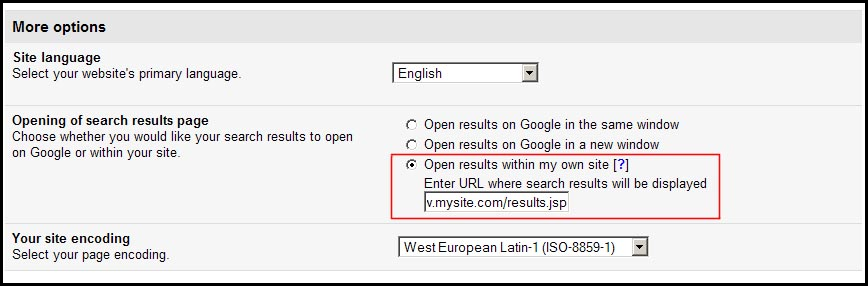
To use it, just choose the "Open results within my own site" radio button when you're generating your AdSense for search code. You'll also need to identify the page where you'd like to display your search results.

We'll give you two sets of code: one for the search box, and one for search results. Place the first set on a page where you'd like the search box to appear, and the second set on the page you'd like the search results to appear. Whenever users perform searches on your AdSense for search box, they'll be directed to the page on which you placed the search results code.
Since this new feature is part of AdSense for search, any Competitive Ad Filter and site-flavored search settings will still function as normal. You can also find detailed instructions for implementing this new option in our Help Center. Keep in mind that if you want your existing search boxes to take advantage of the new feature, you'll need to replace the search box code that's currently on your pages.
To use it, just choose the "Open results within my own site" radio button when you're generating your AdSense for search code. You'll also need to identify the page where you'd like to display your search results.
We'll give you two sets of code: one for the search box, and one for search results. Place the first set on a page where you'd like the search box to appear, and the second set on the page you'd like the search results to appear. Whenever users perform searches on your AdSense for search box, they'll be directed to the page on which you placed the search results code.
Since this new feature is part of AdSense for search, any Competitive Ad Filter and site-flavored search settings will still function as normal. You can also find detailed instructions for implementing this new option in our Help Center. Keep in mind that if you want your existing search boxes to take advantage of the new feature, you'll need to replace the search box code that's currently on your pages.
Tuesday, 15 August 2006
Referrals around the world
Back in May, we launched our new and improved referral buttons. Now these new buttons are available for additional products and languages. You can choose from several different colors and options, and the buttons are in a sleeker, web-friendly GIF format -- all the better to blend in with your site.

Publishers have found that it’s most beneficial to place referrals where they're relevant. Do you run a photo blog? Try using a Picasa referral button. Looking to boost revenue for your web hosting site? Implement a Firefox referral button and watch your earnings grow.
Don’t forget you can also implement referrals in a text link format. Text links easily integrate into your site and often convert better than buttons. Here are a few tips on generating more revenue with text links:

If you’re not already displaying referrals on your site, you may be missing out! Publishers have let us know that they’ve seen an increase in earnings since they implemented the feature. One publisher with a history-related site told us, “I get 3,000 uniques a day, and was only making about $15/day with regular AdSense for content. Today, I tried Firefox referrals and beside my regular site income, I've already made an extra $17.20 -- and the day isn't over yet.”
Not only will you benefit from the extra earnings, but your users will learn more about other products such as Picasa, Firefox, and AdWords. To begin displaying the new referral buttons, simply choose Referrals from the AdSense Setup page of your account, then select the product you'd like to refer users to on your pages.

Publishers have found that it’s most beneficial to place referrals where they're relevant. Do you run a photo blog? Try using a Picasa referral button. Looking to boost revenue for your web hosting site? Implement a Firefox referral button and watch your earnings grow.
Don’t forget you can also implement referrals in a text link format. Text links easily integrate into your site and often convert better than buttons. Here are a few tips on generating more revenue with text links:
- You can endorse products you've enjoyed using and encourage your users to do the same.
- Use text links to integrate the ad more seamlessly within your site content.
- Try having the text links inherit the font and look of your site, so they fit in with your current text style and size.

If you’re not already displaying referrals on your site, you may be missing out! Publishers have let us know that they’ve seen an increase in earnings since they implemented the feature. One publisher with a history-related site told us, “I get 3,000 uniques a day, and was only making about $15/day with regular AdSense for content. Today, I tried Firefox referrals and beside my regular site income, I've already made an extra $17.20 -- and the day isn't over yet.”
Not only will you benefit from the extra earnings, but your users will learn more about other products such as Picasa, Firefox, and AdWords. To begin displaying the new referral buttons, simply choose Referrals from the AdSense Setup page of your account, then select the product you'd like to refer users to on your pages.
Monday, 14 August 2006
Optimization Month, Week 3: The many features of AdSense
 At this point, you probably know your ads like the back of your hand. You've removed the borders, relocated them above the fold, and are awaiting results. In the meantime, you might be asking: "What else can I do to optimize?"
I’m glad you asked. AdSense isn't just ads; within your account, there are a number of features that you might never have noticed. This week we'll be focusing on some of these less-visible gems that can also contribute to revenue increases. As the saying goes, don't put all your ads in one basket. ;) Diversify with some other features!
Maybe your site is full of great content users will love (if only they can find what they're looking for) or maybe you're already using your own search model, but don't have a way to monetize it. In either case, AdSense for search is a great solution.
If your users are always looking for new products and services to try, and you're looking always looking for a new revenue stream, give referrals a gander.
Once your ads are visually appealing enough to catch the eye, they still need to catch your visitor's interest. You can use section targeting to emphasize the important parts of your content (of course it’s all important, but who are we kidding? Not all content is created equal).
You know your site is great. Advertisers know your site is great. Wouldn't it be great if they could easily target ads right to your site? They can, using Onsite Advertiser Sign-up.
We'll explore these features in more depth throughout the week, so be sure to check in again for more details.
Friday, 11 August 2006
Phoebe's ad design tips
 (Photo: Cody Ho assuming photo responsibilities for Phoebe Ho)
I can understand throwing away a penny here and there, but it would be pretty ridiculous to toss out hundreds of dollars every day. This is how I feel about optimization. There are many simple ways to increase revenue, but publishers often overlook how easy it is to make changes. Take the case of one publisher, who tried changing his 468x60 banner to a 300x250 rectangle and saw his revenue double! Afterwards, of course, he regretted not making the change earlier.
My goal is to make sure you don't have the same regret when you realize you could have already made extra money -- if only you'd optimized sooner. So in order of "biggest bang for the buck," here goes:
1) Make sure your colors are appropriate for your site and ad location. It's the easiest change to make that can increase your revenue up to 4x!
2) When choosing formats, remember: "Wider is better." Though you always want to be sure the format fits into the space on your pages, use 160x600 instead of 120x600 and try using rectangles as much as you can. 336x280 and 300x250 are our best performing formats. And since they support image and video ads, you'll even have more advertisers bidding on these ad spaces than other formats.
3) Like Geoff said earlier this week, "Set your site on fire!". Make sure you place the ads where your users will see them. This is why "above the fold" is so popular, because most users will not scroll below the fold line. In the same way, people often look for menu bars on the left side of a page so ads in that location are "hot." If your design layout allows it, sandwich the ads with content: placing a rectangle in the middle of a long article not only helps your visitors read those ads, but it also gives them a visual break.
Just try these tips -- it may take you 5 minutes or an hour, but you'll never know until you do if they will make you even more money. What have you got to lose?
Thursday, 10 August 2006
Content is king
You already know that AdSense works by crawling your web pages for content, then delivering ads based on that content. This means that if your content is limited, our crawler may have difficulty identifying the information on the page. As a result, you may see ads that are not directly relevant to your page, or public service ads.
Here's a fix: Ensure that your pages are full of compelling content. The more targeted, full-text information you provide to our crawler, the easier it will be for our system to determine what your pages are about, and the greater the relevance of the Google ads will be. This enhances the effectiveness of the AdSense program, resulting in a better experience for your users, not to mention for the advertisers appearing on your pages.
Here’s a simple equation that spells it out:
The Google ads appearing on your site then serve as supplemental content, providing useful information to your users that pertains to the content you’ve worked so hard to develop. So help us help you -- optimize your page with good content.
UPDATED for accuracy
Here's a fix: Ensure that your pages are full of compelling content. The more targeted, full-text information you provide to our crawler, the easier it will be for our system to determine what your pages are about, and the greater the relevance of the Google ads will be. This enhances the effectiveness of the AdSense program, resulting in a better experience for your users, not to mention for the advertisers appearing on your pages.
Here’s a simple equation that spells it out:
- A content-rich page = Highly-targeted ads
- Highly-targeted ads + Interested users = Healthy clickthrough & conversion rates
- Healthy clickthrough & conversion rates = Success!
The Google ads appearing on your site then serve as supplemental content, providing useful information to your users that pertains to the content you’ve worked so hard to develop. So help us help you -- optimize your page with good content.
UPDATED for accuracy
Co-optimization: Learning from others to earn more
If you've been trying out some of our Optimization Month tips on your site and wondering whether you're on the right track, you're not alone. Based on your feedback, we're excited to let you know that we've added a new category to the AdSense Help Forum -- Optimization! Now you can share your optimization results, ideas, and questions with other publishers in the AdSense community who are going through the same process.
There's no better way to learn than from the experiences of others, so why not get started during this Optimization Month?
There's no better way to learn than from the experiences of others, so why not get started during this Optimization Month?
Wednesday, 9 August 2006
Colors that make cents (and dollars)
Scene 1: You walk into an elegant formal dining room done up in silk ivory at every turn. Guests attired in tuxedos and evening gowns mill about in the dim, romantic lighting. As you gaze around the room, your eyes are immediately drawn to a guest wearing a bright orange tuxedo and magenta top hat.
Scene 2: You stroll down the trendiest street in a cosmopolitan city, surrounded by flashy billboards and vibrant window displays. Gleaming Italian sports cars roar past you as you head to a nearby 4-star restaurant. Next to this fine dining establishment, you gawk at the small one-story cement building next to it, on top of which looms a 50-foot-tall inflated gorilla, advertising an upcoming used car sale.
Tip: Don't let your ads be the orange tuxedo or the giant inflated gorilla. Their design should be determined with respect to their surroundings (your site) and their viewers -- your site's users.
Blending your ads in with the color scheme of your site decreases ad blindness and in most cases can increase revenue. However, you should always keep in mind how your users will respond, and test what colors your users will respond to. (Sometimes it's okay to stand out a little.)
Take Neopets, for example -- a website for kids to adopt, nurture, and play games with their virtual pets. Chris Davis, the VP of sales for Neopets, used channels and A/B testing to discover that bolder colors which made his ads stand out worked better than blended colors. After making changes to his ads, Chris was able to double both his clickthrough rate and his revenue.
Before:

After:

During this Optimization Month, follow Chris' example and test whether your ad colors are the best ones for your site by using channels and A/B testing. Being smart about your site and your users can yield great results.
Scene 2: You stroll down the trendiest street in a cosmopolitan city, surrounded by flashy billboards and vibrant window displays. Gleaming Italian sports cars roar past you as you head to a nearby 4-star restaurant. Next to this fine dining establishment, you gawk at the small one-story cement building next to it, on top of which looms a 50-foot-tall inflated gorilla, advertising an upcoming used car sale.
Tip: Don't let your ads be the orange tuxedo or the giant inflated gorilla. Their design should be determined with respect to their surroundings (your site) and their viewers -- your site's users.
Blending your ads in with the color scheme of your site decreases ad blindness and in most cases can increase revenue. However, you should always keep in mind how your users will respond, and test what colors your users will respond to. (Sometimes it's okay to stand out a little.)
Take Neopets, for example -- a website for kids to adopt, nurture, and play games with their virtual pets. Chris Davis, the VP of sales for Neopets, used channels and A/B testing to discover that bolder colors which made his ads stand out worked better than blended colors. After making changes to his ads, Chris was able to double both his clickthrough rate and his revenue.
Before:

After:

During this Optimization Month, follow Chris' example and test whether your ad colors are the best ones for your site by using channels and A/B testing. Being smart about your site and your users can yield great results.
Set your site on fire!
On the AdSense team we're always talking about "hot" (good) and "cold" (bad) ad placement. I love this approach and I find myself analyzing my everyday life in the same way.
Just the other day, I had some friends over for dinner and placed the appetizer in a very "cold" place, in particular, a coffee table that my puppy Tori could reach. Needless to say, she wasted no time teaching me a lesson by eating the salmon in one gigantic bite. She was satisfied, and I was down about $20.
The lesson for AdSense is that "cold" ad placement on your pages can cost you, so if you're looking to maximize your earnings, try to place your ads in "hot" places on your site. (This can be hard to figure out because often you're juggling your users' experience and the existing layout of your site.)
The most general tip I can give is that an ad placed above the fold is "hot," and one placed below the fold is "cold." I'm not sure if that rhyme at the end will help you remember this, but I sure hope that it does. Beyond that, you need to start thinking about your site design in order to create the "hottest" ad placement. The first thing you should consider is whether your site is vertically or horizontally organized. If your site is vertically based, you might consider trying to integrate a "blazing" skyscraper on the left hand side of your pages. On the other hand, for more horizontally laid out sites I love seeing a "smoking" leaderboard placed right below the title or the first section of content. Both of these placements fit within our traditional heatmap and should work well on your sites.
The next thing you should consider is placing your ad in the "hottest" spot of them all -- the middle of the page above the fold. Let me qualify this by saying that placing a one of our button or half-banner ad formats in this location just for the sake of having an ad in this middle of the page is not a good idea. In keeping with the vertical vs. horizontal theme, you should look to see if leaderboard, banner or rectangle will fit for you and your users in this location. Other considerations are whether or not the ad itself can be wrapped by your content or if it will function as a divider between two sections of content or navigation.
I hope that the story about Tori the puppy and these examples help you create the hottest site possible. One last note: you'll never know what type of results you can get without experimenting. So start seeing what hot spots your site holds for you.
P.S. No animals were harmed in the writing of this post!
Just the other day, I had some friends over for dinner and placed the appetizer in a very "cold" place, in particular, a coffee table that my puppy Tori could reach. Needless to say, she wasted no time teaching me a lesson by eating the salmon in one gigantic bite. She was satisfied, and I was down about $20.
The lesson for AdSense is that "cold" ad placement on your pages can cost you, so if you're looking to maximize your earnings, try to place your ads in "hot" places on your site. (This can be hard to figure out because often you're juggling your users' experience and the existing layout of your site.)
The most general tip I can give is that an ad placed above the fold is "hot," and one placed below the fold is "cold." I'm not sure if that rhyme at the end will help you remember this, but I sure hope that it does. Beyond that, you need to start thinking about your site design in order to create the "hottest" ad placement. The first thing you should consider is whether your site is vertically or horizontally organized. If your site is vertically based, you might consider trying to integrate a "blazing" skyscraper on the left hand side of your pages. On the other hand, for more horizontally laid out sites I love seeing a "smoking" leaderboard placed right below the title or the first section of content. Both of these placements fit within our traditional heatmap and should work well on your sites.
The next thing you should consider is placing your ad in the "hottest" spot of them all -- the middle of the page above the fold. Let me qualify this by saying that placing a one of our button or half-banner ad formats in this location just for the sake of having an ad in this middle of the page is not a good idea. In keeping with the vertical vs. horizontal theme, you should look to see if leaderboard, banner or rectangle will fit for you and your users in this location. Other considerations are whether or not the ad itself can be wrapped by your content or if it will function as a divider between two sections of content or navigation.
I hope that the story about Tori the puppy and these examples help you create the hottest site possible. One last note: you'll never know what type of results you can get without experimenting. So start seeing what hot spots your site holds for you.
P.S. No animals were harmed in the writing of this post!
Tuesday, 8 August 2006
For every optimization action, there is a user reaction
You build a site to attract visitors, but the more visitors you get, the more expensive it becomes to maintain the site. So, like many other publishers, you turn to online advertisements for revenue. But if your visitors don't find the ads useful (or worse, find them obtrusive), you could potentially end up losing both users and your revenue stream.
So for this week’s post on placement optimization, we’ll focus on the behavior, and the reaction, of users.
User Behavior
AdSense’s content-matching technology is designed to provide useful links and resources for your site’s visitors -- but they won’t find the links useful if they can’t find them at all!
User Reaction
As emphasized previously, you know your visitors best, so we encourage you to be sensitive to their needs and interests.
So for this week’s post on placement optimization, we’ll focus on the behavior, and the reaction, of users.
User Behavior
AdSense’s content-matching technology is designed to provide useful links and resources for your site’s visitors -- but they won’t find the links useful if they can’t find them at all!
- Take a look at each page on your site and imagine yourself as one of your site's visitors. Would he or she rarely scroll down? If so, be sure to place an ad unit above the fold. If there is plenty of engaging content below the fold, feel free to monetize the space with more ad units.
- The typical newbie mistake is to place a leaderboard at the very top of the page. In our tests, however, we’ve found that users’ line of vision typically goes straight to the area below the header. You might find that moving the top leaderboard or banner below your site’s header would most likely result in an increase in CTR.
- On that same note, there is a significant difference in having an ad unit directly after your content versus after the footer, the “contact us” link, or a chunk of white space (remember: white spaces don’t make you money!). One publisher who had a border around his articles saw a 300% increase in CTR when he simply moved his ad unit within the border. Similarly with forums, moving a leaderboard from under the footer to directly after the last post typically results in a 200% increase.
- And the best tip we have in this category is (you’ve guessed it): an embedded rectangle unit. An ad within an article can serve as a “commercial break” for users who are tired of reading. Not only are CTRs usually in the range of .5%-2%, but they’re also a popular unit for site-targeting campaigns.
User Reaction
As emphasized previously, you know your visitors best, so we encourage you to be sensitive to their needs and interests.
- If the content is generated by your users, e.g. via forums and profile pages, they most likely won't want their content to be interrupted by an ad. Some publishers have established a premium membership plan that removes all ads for paying members, but monetizes all non-premium member pages with ads.
- For any dramatic changes in ad placement, you can certainly try making the change to a small percentage of the site to see how your users respond. If your CTR is substantially higher with the new placement, that may be an indication that people are finding the ads useful rather than obtrusive.
- Review your page content to see if visitors would prefer to have related links after reading the content. One publisher said, “Text-based ads work especially well in placements where the user expects and wants links that are related to the main content. However, we don’t trick the user and instead experiment rather conservatively – and we concentrate on the things that matter in the end: quality of content, usability and service. If you find the right balance, you will be able to successfully monetize your website with ads while providing a positive user experience to your visitors.”
Subscribe to:
Posts (Atom)